Old Citadel location and chest guide
Gothic Remake Old Citadel: Location, Underground Route & Chest Checks
The Old Citadel search usually mixes three questions: where the ruins are, how to reach the underground area, and whether a nearby chest needs a key or a live lockpicking route. This guide keeps those clues separate so a community report for one object does not become a false fixed answer for another.
Quick answer: identify the area before opening the chest
For the Gothic Remake Old Citadel, start from a stable landmark and confirm the same approach, courtyard, wall break, and underground entrance described in your report. The words Old Citadel can refer to the wider ruins as well as a particular cellar or chest, so the name alone is not enough to identify one object.
Once the route is clear, inspect the interaction prompt. A key request is an access or progression problem; a plate interface is a lockpicking problem. Only the second case can be mapped in the chest solver. This distinction is the fastest way to avoid spending lockpicks on a chest that is waiting for a route or key.
Map a live lock in the chest solverIdentify the Gothic Remake Old Citadel before following a chest report
The strongest first step is object identification, not a combination lookup. Write down the direction from which you entered, the nearest gate or arch, the courtyard shape, the highest visible tower, and whether the chest is above ground or below a stair. These details are more reliable than a short video title or a forum comment that only says Old Citadel chest.
Search data also shows why the phrase is easy to misread. The broad Gothic Remake Old Citadel query has an informational intent, while Old Citadel chest Gothic Remake is a narrower companion phrase. A useful page therefore needs both a location answer and a chest-triage answer. It should not promise that every container in the ruins shares one key, one route, or one lock state.
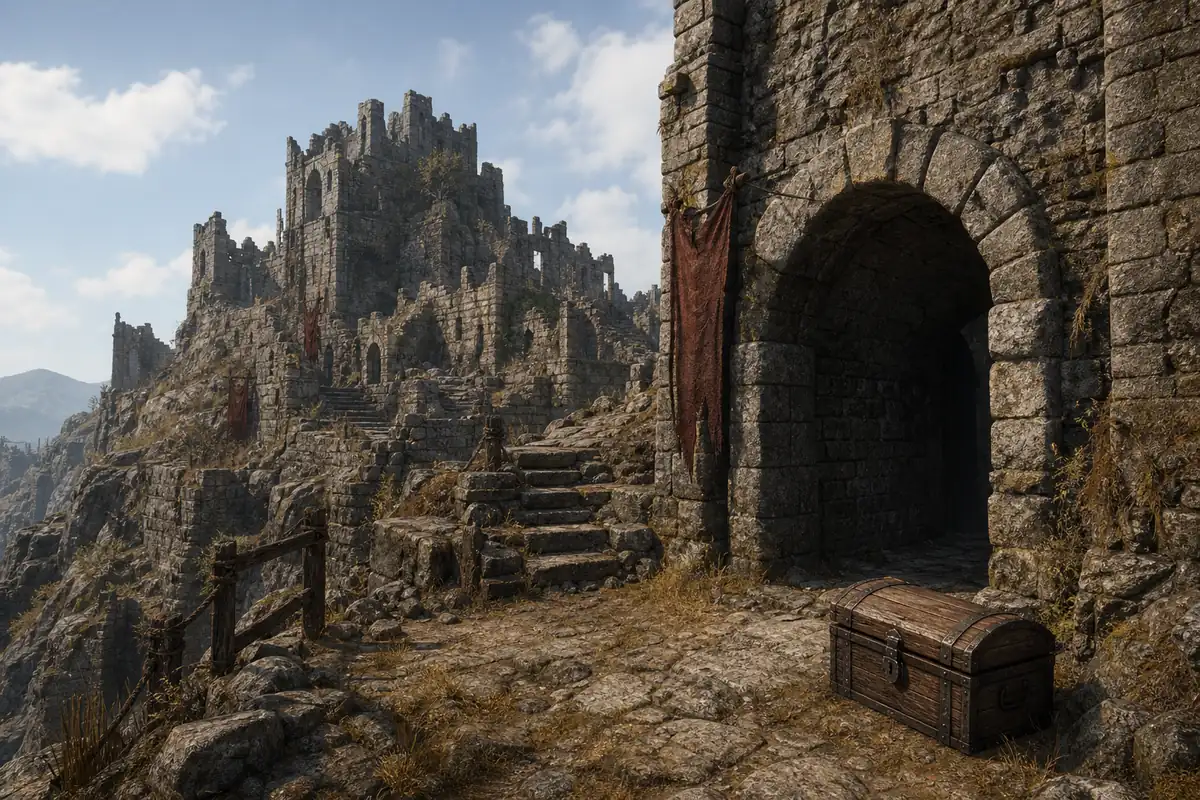
Treat the feature illustration on this page as a visual memory aid only. It communicates the kind of ruined approach and arched access that can help you compare notes, but it does not claim to reproduce the game geometry. Use the live game scene and the interactive map for the final route check.
Old Citadel location: use landmarks, not a copied coordinate
A location answer is useful when it gives you a repeatable observation path. Start outside the ruins and note the first broken wall or gate you pass. From there, confirm the courtyard or upper platform before descending. If a report sends you straight to a chest but you cannot reproduce its approach, stop and check whether it describes a nearby room, a different elevation, or a different progression state.
The map layer and the chest layer solve different problems. An interactive map can help you understand the region and compare named landmarks. It cannot prove that a marker's chest is the same object you are looking at, and it cannot provide a valid plate sequence without the current lock state. Keep the route note, the object identity, and the lock observation as three separate pieces of evidence.
When a player report uses terms such as ruins, cellar, tower, or underground, repeat the route from the last landmark that both players can see. A matching name with a different approach is a warning sign. Take a short note or screenshot for your own comparison, then continue only after the entrance, room, and chest position agree.
How to enter the Old Citadel underground area
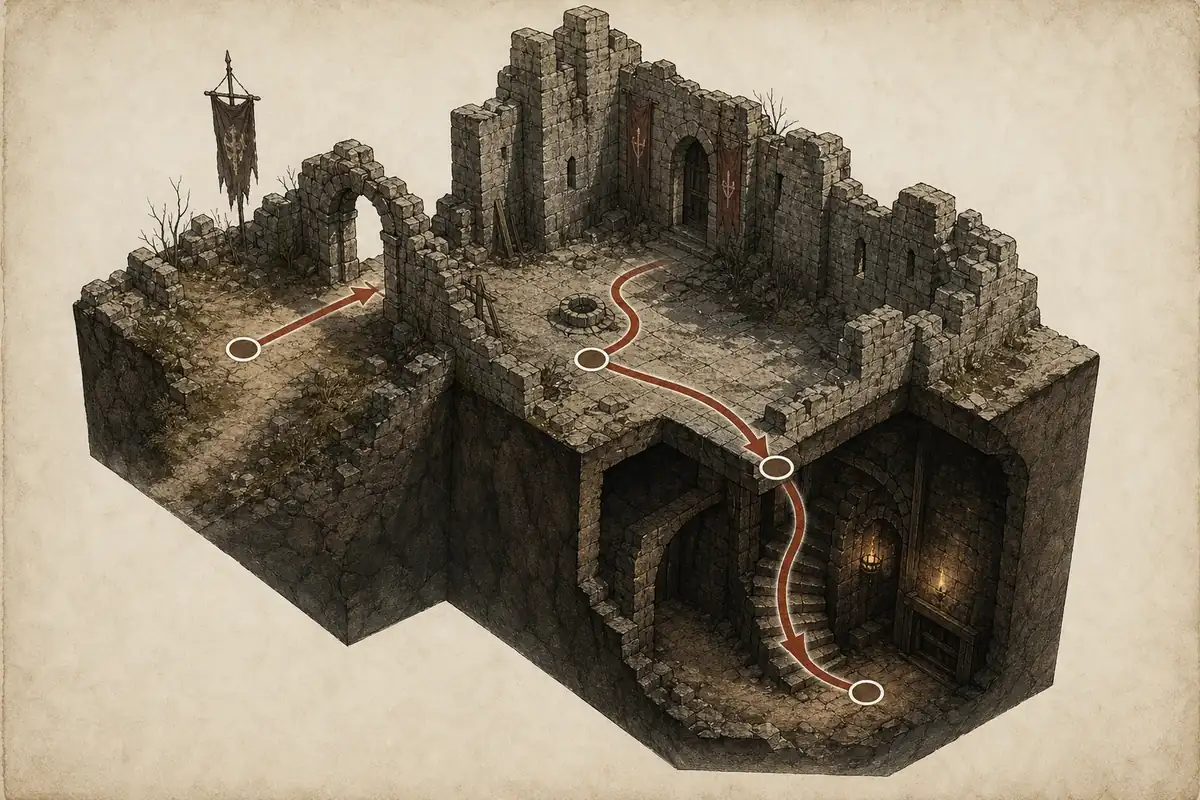
The long-tail question about entering the Old Citadel underground is usually a route question. Look for the descent that belongs to the same ruin section as the chest: a stair, a cellar opening, a gate, or a side passage can lead to different containers. Do not assume that a visible chest across a gap is the one reached by the first underground route you find.
Use a three-point check before you call a route blocked. First, return to the last stable landmark and confirm the direction. Second, inspect the whole height of the ruin for a higher or lower approach rather than walking directly at the chest. Third, check whether the game is asking for a key, a lever, or a lockpick interaction. Each prompt changes the next action.
If a bridge, broken ledge, or sealed doorway is involved, record it as an access fact rather than as proof of a locked chest. A failed jump and a locked container look similar in a short clip because both stop progress, but they require different solutions. The route illustration above is deliberately generic for that reason: it shows the decision order without inventing a precise map.
| What you observe | Likely problem | Next check |
|---|---|---|
| The chest is visible but the path ends at a gap | Route or progression | Search for a higher approach, side path, switch, or key prompt |
| The interaction asks for a key | Access or quest state | Confirm the chest identity and trace the key clue |
| The interaction opens a plate-based lock | Live lockpicking state | Record plate holes and test one active plate |
| A copied sequence fails on the first move | Wrong object, state, or direction | Reload or remap the current lock before continuing |
A route illustration is not an exact game map. Verify every entrance in the live scene.Old Citadel chest: key, route, or lockpicking?
The phrase Gothic Remake Old Citadel chest can describe different interactions. Before you search for a combination, read the prompt and look at the object itself. A normal key request does not become a plate puzzle because a different chest in the same ruins has a reported lock sequence. Conversely, a plate lock should not be forced open with a key route copied from a nearby container.
A practical decision tree is simple. If you cannot reach the chest, solve navigation first. If you can reach it and the prompt asks for a key, identify the required access clue. If you can reach it and the plate interface is visible, capture the live state and use the solver. If your first controlled move disagrees with the prediction, stop immediately; the mismatch is useful evidence that the object or relationship row was recorded incorrectly.
This approach also keeps community reports useful without overclaiming them. A video can show a route or a successful opening, but it may omit the starting state, game build, or exact chest identity. Use it as a lead, then reproduce the relevant observation in your own game.
Record a live Old Citadel lock before using the solver
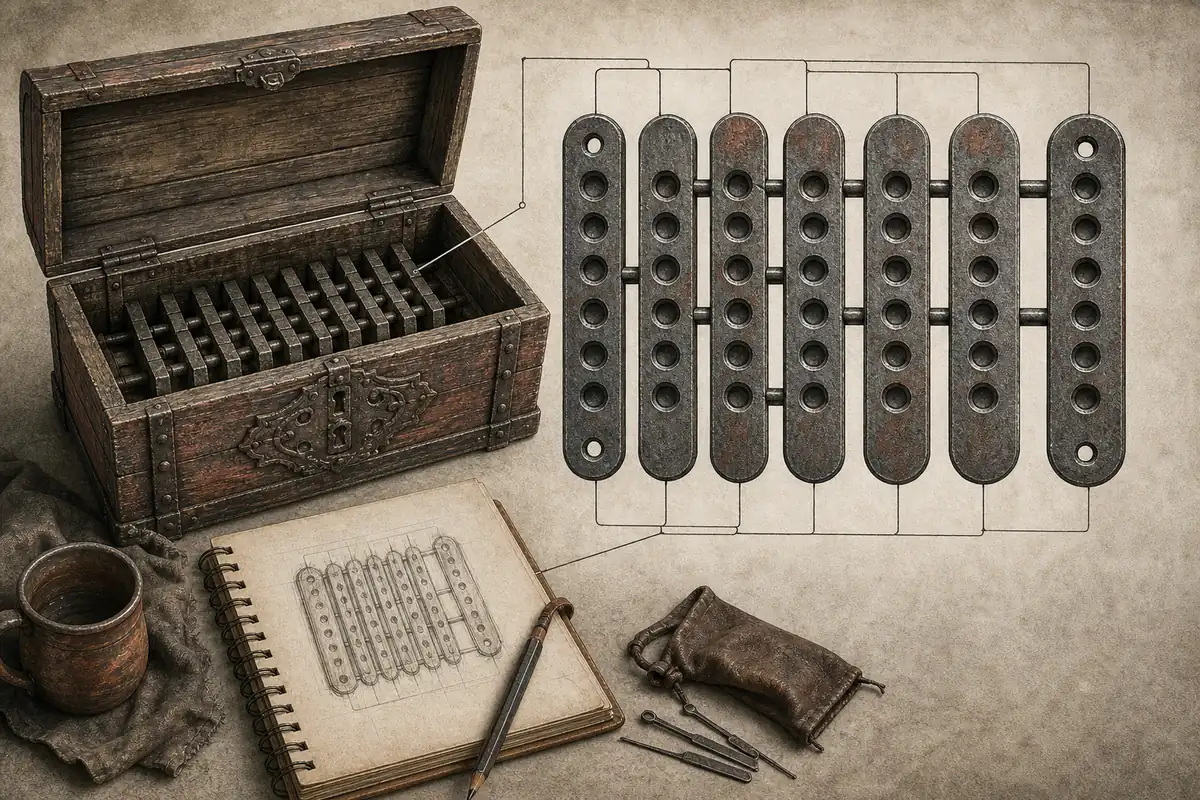
A plate lock is a small state-recording problem. First count the visible plates and number them consistently from back to front. Then record the current hole on every track before testing anything. The solver assumes that the starting vector is the state on screen now; a route copied from an earlier attempt is not valid after extra key presses or a failed test.
Next, move exactly one active plate once and compare every plate afterward. Mark a linked reaction as Same, Opposite, or None according to the observed direction. Relationships are directional: the row for the plate you moved describes the reaction caused by that action. Do not mirror a row just because two plates appear physically close. A single reversed relationship can produce a route that looks plausible until the first checkpoint.
Use the expected-state line in the result as a live check. Pause after each movement and compare the entire vector, not only the active plate. If one position differs, update the starting state, repeat the uncertain observation from a clean reload, or leave the chest for a later attempt. The goal is a reproducible route, not a confident-looking sequence.
Evidence boundaries: what this Old Citadel guide can and cannot prove
The official game store page is useful for confirming the game identity and broad visual setting, but it does not document the contents of an individual Old Citadel chest. Community maps, walkthroughs, and discussion posts can add route clues, yet they may describe a different build, a different container, or a different quest state. Label those clues as community evidence instead of presenting them as an official chest table.
This page therefore does not publish a universal Old Citadel combination, guaranteed reward list, or invented coordinate. Those claims need a reproducible object identity and a current in-game observation. When a source supplies only a name, treat it as a search lead. When it supplies a route, compare the landmarks. When it supplies a lock sequence, compare the plate count, starting holes, first move, and expected states before trusting it.
The linked-plate model used by the solver is a planning aid based on visible observations. It cannot detect an unreleased patch, a mod, an input that the game rejected, or a chest that is not the one described. Keeping those limits visible makes a mismatch actionable: you know whether to revisit the map, find the key, or remap the lock.
Old Citadel chest FAQ
Where is the Old Citadel in Gothic Remake?
Use the area name together with the approach, courtyard, wall break, and elevation described by the source. The phrase can refer to wider ruins or a specific underground section, so compare the live landmarks with the interactive map instead of trusting a name alone.
How do I enter the Old Citadel underground area?
Treat the underground question as a route check first. Return to the last landmark, inspect higher and lower approaches, and identify whether the blocking prompt asks for a key, a lever, or a lockpick. A broken bridge is not proof that the nearby chest is locked.
Does the Gothic Remake Old Citadel chest have a fixed combination?
Do not assume a universal combination. A plate lock depends on the visible starting holes and directional relationships, while a key chest is a different interaction. Use a fixed sequence only when the object, plate count, starting state, first move, and build context all match.
Can I use the Gothic Remake chest solver for an Old Citadel chest?
Yes, when the chest shows the linked plate interface. Record the current holes, test one active plate, enter Same, Opposite, or None reactions, and follow the expected states. The solver cannot replace a key or navigation route.
Why does an Old Citadel chest guide mention a key when my chest needs lockpicking?
The name may cover more than one container or progression state. Separate the route and object identity from the interaction prompt. A key report and a plate-lock report should not be merged into one fixed answer without matching landmarks and live evidence.
Is this the official Gothic Remake Old Citadel guide?
No. This is an independent fan guide. Official store material is used only for broad game context; route clues and lock observations must be checked against the live game and clearly identified community evidence.
Why can two Old Citadel chest routes be different?
Reports can refer to different containers, approaches, quest states, game builds, or lock starting vectors. Compare the first stable landmark and the first expected lock state before deciding that one report is wrong.
Summary
For the Gothic Remake Old Citadel, solve the problems in order: identify the ruins, reproduce the route to the correct underground or courtyard area, and read the interaction prompt before looking for a chest answer.
A key request needs an access clue. A plate interface needs a current state and directional observations. If you use the solver, pause at each expected state and remap as soon as the live chest differs.
The Old Citadel page is a decision layer between the interactive map, the broad chest-locations hub, the lockpicking guide, and the browser solver. It intentionally avoids presenting a community report as an official fixed code or guaranteed reward list.
Sources and verification boundaries
- Gothic 1 Remake official Steam pageOfficial game-context source; it does not verify the location, contents, or lock state of an individual Old Citadel chest.
- Gothic.Tools lockpicking and chest referenceCommunity reference for general lockpicking terminology and solution context, not an official Old Citadel chest code.